
Napier L48
Six enormous cylinders made their power smoothly enough for a car to become Britain’s first 100-mph record breaker.
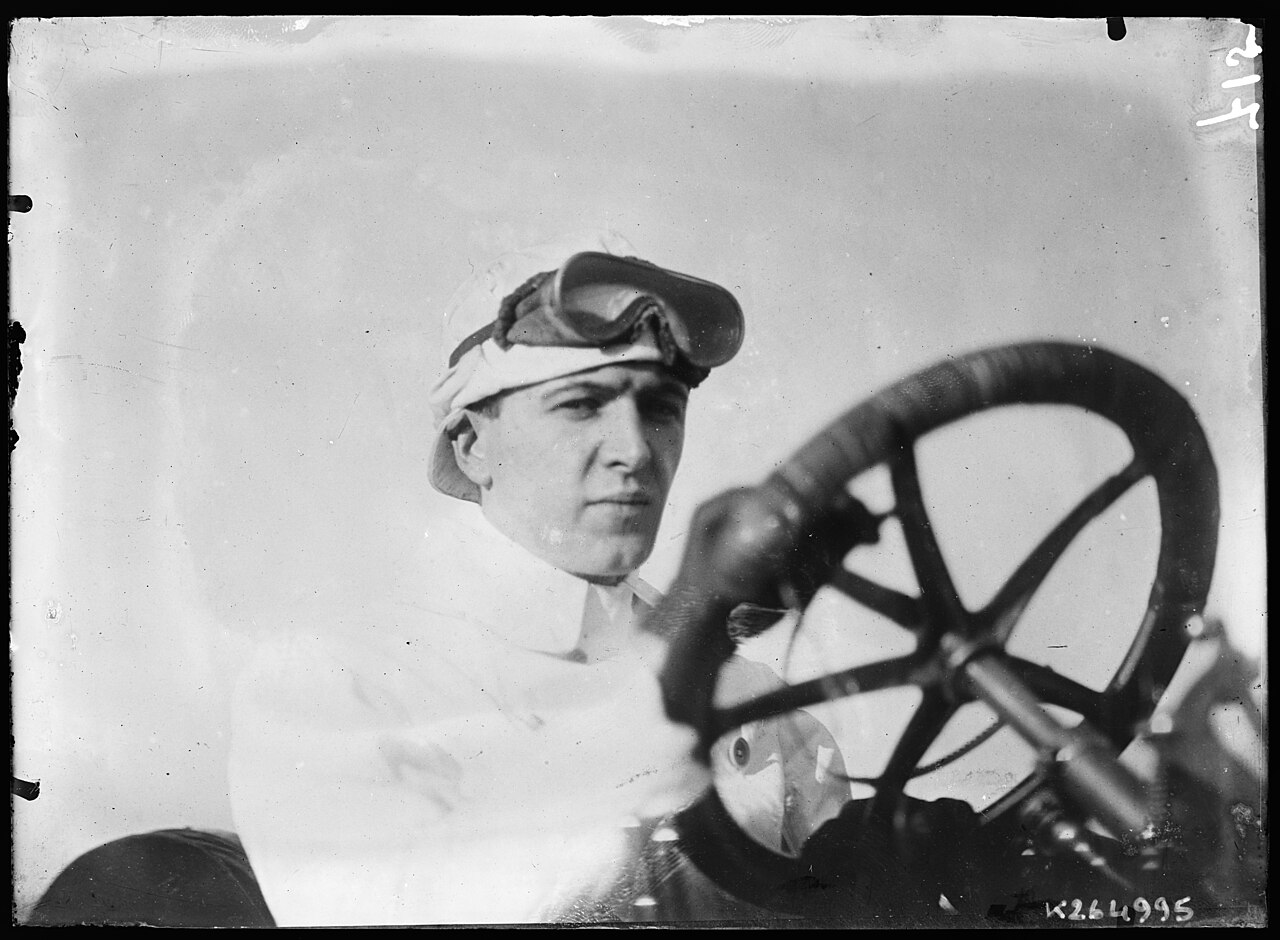
(Arthur) Macdonald (au volant de sa Napier, janvier 1905) - btv1b53225682k.jpg · Agence Rol / Bibliotheque nationale de France · Public domain (PD-France and PD-US-expired)
Research pending
A matching completed auction sale has not been verified for this exact year, body, trim, engine, transmission and market.
Joyride shows this gap instead of substituting an asking price, unsold bid or mismatched special vehicle.
More than a set of wheels.
Napier built the L48 in 1904 for competition and speed trials. It was first shown in June and soon set fastest time at Portmarnock Sands. In January 1905 Arthur Macdonald drove the 15-litre six-cylinder car at 104.65 mph over the flying mile at Ormond-Daytona Beach. The original chassis was later altered, fitted with a still larger engine and eventually broken up; the first engine survived in an Australian speedboat and became the heart of a careful reconstruction completed in 1982.
Look a little closer.
The name “Samson” belongs to the car’s later, bigger-engine life; it should not be used as if every 1904–1905 L48 record was set in that later configuration.
Photos show an example of the model or generation. The pictured vehicle’s year, equipment, or modifications can differ from the specification described here.
A record car with two distinct lives
The 1905 record used the original roughly 15-litre engine. Later the chassis received an engine of more than 20 litres and became known as Samson. Keeping those phases separate prevents the later Brooklands speeds and giant-engine identity from being pasted onto the earlier Ormond-Daytona car.
Source: Motoring Past · 1904 Napier L48 Samson history ↗Why the surviving car is a reconstruction
The original 15-litre engine went to Australia in 1908 and powered the Nautilus II speedboat. Bob Chamberlain found it in 1950, began reconstructing the car in 1977 from factory drawings and photographs, and first ran the completed machine in 1982. Its 240 bhp figure is explicitly “as restored,” not a period dynamometer claim.
Source: Motoring Past · reconstruction and original-engine provenance ↗A sparse cockpit built to a weight limit
The 1904 Gordon Bennett rules imposed a 1,000 kg limit, so the L48 saved weight aggressively. Motor Sport’s reconstruction history says the original design left out floorboards and had room for only a two-speed gearbox. The January 1905 photograph therefore belongs with instrument and control evidence: it clearly records Macdonald’s seating position and the large steering wheel, but it does not reveal a readable dial panel. Joyride does not invent a modern cluster where the surviving evidence does not show one.
Source: Motor Sport · Napier L48 reconstruction and original layout ↗How the recreated controls felt
After the original-engine reconstruction first ran in 1982, Bob Chamberlain described the steering as heavy but neutral, with no kickback at the wheel, and said the gear change was difficult even for an experienced early-car driver. These are observations from the reconstruction, not a surviving 1905 road test, so they explain the recreated control behavior without being presented as direct evidence of Macdonald’s exact car in period.
Source: Motor Sport · first driving report after the L48 reconstruction ↗Where these facts come from
- Motoring Past · The Napier L48 history and reconstruction
- Bonhams · reconstructed 1904 Gordon Bennett Napier L48 technical summary
- Linkage Magazine · Bonhams presents the 1904 Napier L48
- Motor Sport · Napier L48 reconstruction and original layout
- Motor Sport · first driving report after the L48 reconstruction
- Bibliothèque nationale de France / Commons · Arthur Macdonald in the Napier, January 1905
Selected facts checked for this edition. Some source pages link to broader model families. Last reviewed October 1, 2026.