Jaguar D-Type works prototype XKC401
The first D-Type wrapped aircraft-style structure around Jaguar's proven engine and brakes to chase speed at Le Mans.
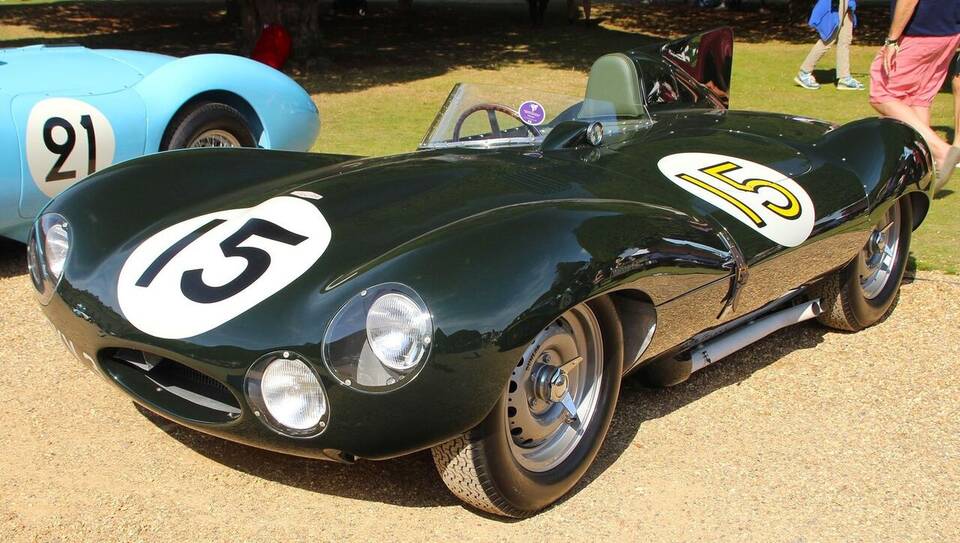
1954 Jaguar D-Type OKV 3 XKC404.jpg · MrWalkr · CC BY-SA 4.0
Research pending
A matching completed auction sale has not been verified for this exact year, body, trim, engine, transmission and market.
Joyride shows this gap instead of substituting an asking price, unsold bid or mismatched special vehicle.
More than a set of wheels.
Jaguar completed prototype XKC401 in May 1954 and drove it from Coventry to Le Mans for testing. Tony Rolt immediately beat the circuit lap record by about five seconds. The D-Type kept useful C-Type hardware—the XK engine, rear suspension and disc brakes—but replaced the older racing frame with an aluminium-and-magnesium monocoque and front subframe. Three works cars followed for the 1954 race; fuel trouble stopped two, while Duncan Hamilton and Tony Rolt finished second. A 1954 works D-Type then won at Reims, and the design went on to win Le Mans in 1955, 1956 and 1957.
Look a little closer.
The prototype was road-driven from Coventry to Le Mans before it broke the circuit lap record in testing.
Photos show an example of the model or generation. The pictured vehicle’s year, equipment, or modifications can differ from the specification described here.
The structure was the real revolution
Jaguar did not simply make a lighter C-Type. The D-Type's driver compartment was a load-bearing aluminium-and-magnesium monocoque, with a separate subframe carrying the engine and front suspension. Concentrating strength in the shell reduced weight and frontal area while giving Malcolm Sayer a clean aerodynamic shape. Jaguar's 2014 history says only the C-Type's engine, rear suspension and disc brakes carried over.
Source: Jaguar Media · 60 years of the D-Type ↗What '1954 short nose' means here
XKC401 first appeared without the famous fin; Jaguar developed that aid after the prototype returned from Le Mans, and the three race cars received fins. Heritage now calls the early cars 'short nose' only in contrast with later long-nose D-Types. Jaguar Classic's continuation programme uses 1955 shortnose and 1956 longnose specifications, so its modern 295/320-bhp figures are not back-applied to this May 1954 prototype.
Source: Jaguar Daimler Heritage Trust · D-Type No. 3 at Reims ↗Where these facts come from
- Jaguar Daimler Heritage Trust · 1954 D-Type XKC401
- Jaguar Media · 60 years of the D-Type
- Jaguar Daimler Heritage Trust · D-Type No. 3 at Reims
- Jaguar · Racing DNA
- Jaguar Classic · D-Type Continuation
Selected facts checked for this edition. Some source pages link to broader model families. Last reviewed October 1, 2026.