Bristol 405 Saloon
An aircraft maker's precise four-door grand tourer
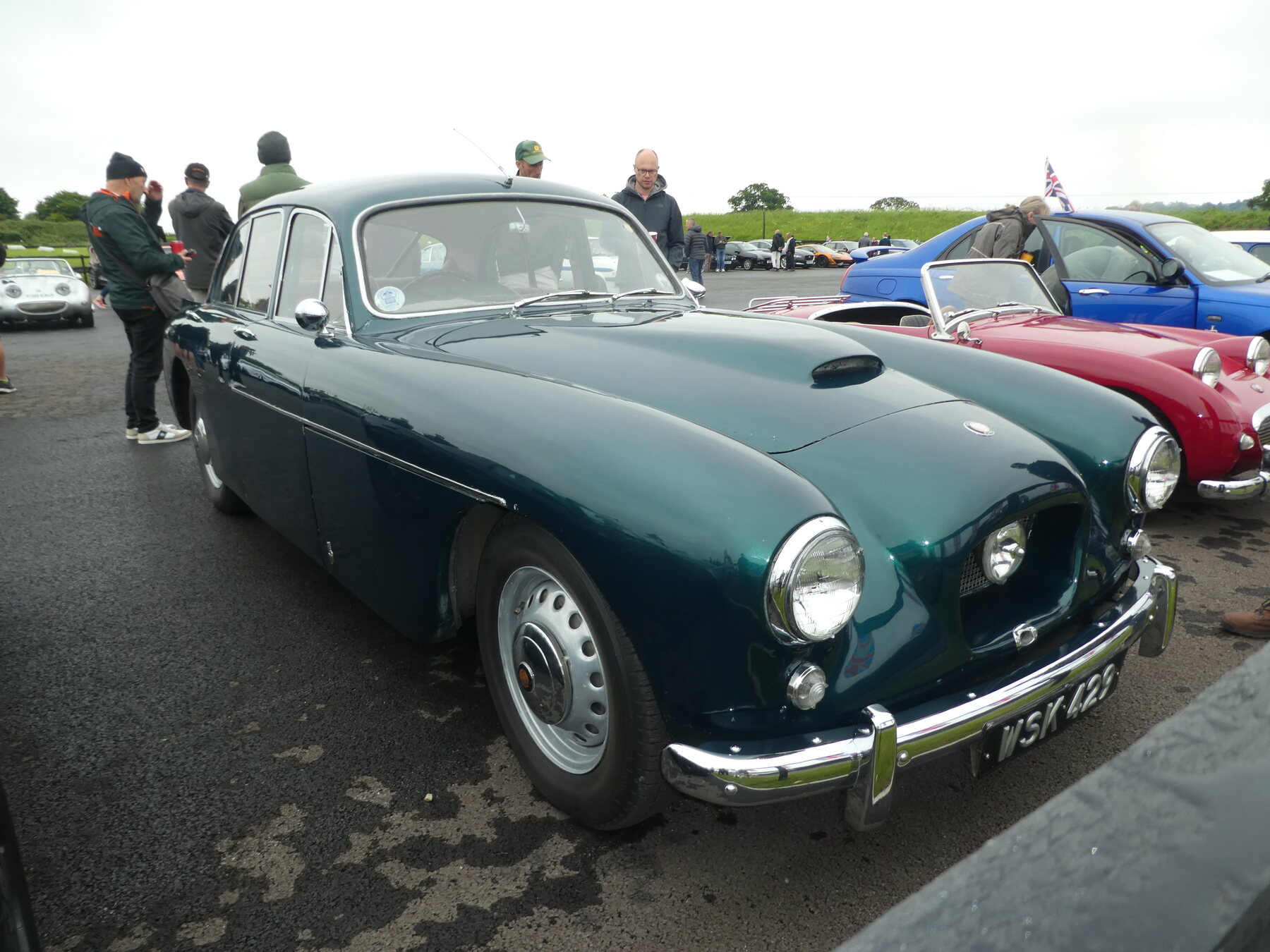
1955 Britain Bristol 405 Saloon · Andrew Bone (andreboeni) · CC BY 2.0
Research pending
A matching completed auction sale has not been verified for this exact year, body, trim, engine, transmission and market.
Joyride shows this gap instead of substituting an asking price, unsold bid or mismatched special vehicle.
More than a set of wheels.
The Bristol Aeroplane Company entered car production after the war with a finely engineered two-litre six-cylinder line. In 1955 the 405 appeared as Bristol's only factory-bodied four-door model, combining four adult seats with a long-legged overdrive gearbox and unusually crisp rack-and-pinion steering. Its distinctive front-wing lockers placed the spare wheel and electrical equipment outside the passenger compartment, turning aircraft-minded packaging discipline into a road-car signature.
Look a little closer.
Bristol brought aircraft-company precision to a rare four-door grand tourer with an overdrive “fifth” cruising ratio.
Photos show an example of the model or generation. The pictured vehicle’s year, equipment, or modifications can differ from the specification described here.
Overdrive as a fifth idea, not a fifth gear pair
Period writers called the overdrive an extra fifth speed because that is how it felt from the driver's seat: engage it in top gear and the engine turns more slowly for the same road speed. Mechanically, however, the car still has a four-speed gearbox plus a separate overdrive unit. The distinction matters because it explains Bristol's character—close driver control when accelerating, followed by quiet, economical high-speed cruising.
Source: Sports and High-Performance Cars at Earls Court, November 1955 ↗How aircraft thinking shaped the packaging
Bristol treated space as something to organise, not merely fill. The 405's four-door cabin carried four people, while separate lockers in the front wings housed bulky service items such as the spare wheel and electrical equipment. Moving those objects out of the passenger and luggage areas improved access and kept the saloon's interior purposeful. It is an automotive echo of aircraft design, where every component's location must justify itself.
Source: Bristol engine models ↗Read the driver’s walnut instrument panel
The February 1956 road-test car grouped its instruments under a hood directly ahead of the driver. A 140-mph speedometer and 7,000-rpm rev counter accompanied oil-temperature, water-temperature and oil-pressure readings, plus fuel and charging indications. These are observations of that tested Saloon, not proof of every 1955 car’s original instruments. A readable, reusable cluster photograph is still needed.
Source: Motor Sport — Bristol 405 road test, February 1956 ↗Try the overdrive thought experiment
At the same reported 80 mph, the test car turned about 4,000 rpm in ordinary top and 3,100 rpm in overdrive. That is roughly 23% fewer engine revolutions, not a measured 23% fuel saving. Its right-hand lever selected overdrive only in top; changing down cancelled it automatically. Picture climbing a hill: a lower gear trades relaxed cruising for more engine speed. These operating details describe the February 1956 test car.
Source: Motor Sport — Bristol 405 road test, February 1956 ↗Where these facts come from
- Bristol 405 Saloon
- Bristol Type 404-405 workshop manual: engine specifications
- Sports and High-Performance Cars at Earls Court, November 1955
- Bristol engine models
- Motor Sport — Bristol 405 road test, February 1956
Selected facts checked for this edition. Some source pages link to broader model families. Last reviewed October 2, 2026.