Ford Thunderbird V8
The first Thunderbird mixed sports-car proportions with a comfortable seat, roll-up windows and everyday Ford mechanical parts.
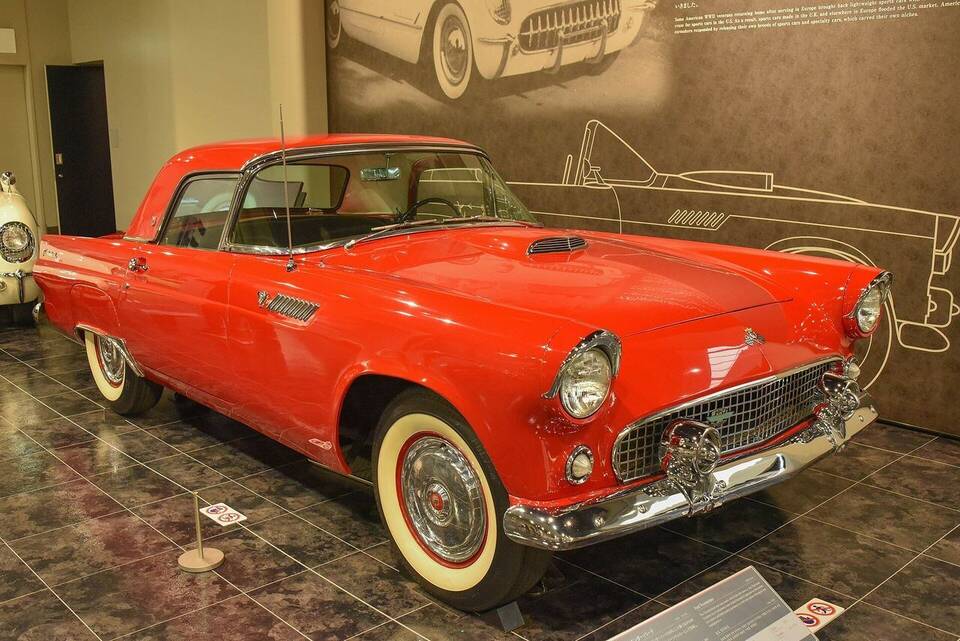
1955 Ford Thunderbird V8 Convertible.jpg · Coolalabright · CC BY 4.0
Research pending
A matching completed auction sale has not been verified for this exact year, body, trim, engine, transmission and market.
Joyride shows this gap instead of substituting an asking price, unsold bid or mismatched special vehicle.
More than a set of wheels.
Ford designers George Walker and Louis Crusoe argued for a sporty two-seater that could use proven production components. The result first appeared at Detroit's post-war auto show on February 20, 1954, and the first production car left Dearborn Assembly that September as a 1955 model. Ford called it a personal car rather than a stripped racing machine: it had V-8 power and a low open body, but also a refined interior and power-assist options. The only engine was Ford's 292-cubic-inch Y-block V-8, with its rating changing slightly according to transmission specification. More than 16,000 were built in the first model year, far beyond the small niche Ford originally expected, and the Thunderbird name grew into a long-running family.
Look a little closer.
Ford received about 5,000 name suggestions before stylist Alden Giberson proposed 'Thunderbird' and earned a $250 suit.
Photos show an example of the model or generation. The pictured vehicle’s year, equipment, or modifications can differ from the specification described here.
Sporty shape, different mission
The Thunderbird arrived after Chevrolet's Corvette, but Ford did not simply copy its brief. The development targets called for two seats, an open top, more than 100 mph and plenty of standard Ford parts. Production cars then added roll-up windows, a telescoping steering wheel, available power steering, power brakes and automatic transmission. That blend explains the phrase 'personal car': it looked ready for fun, while making fewer comfort sacrifices than a competition-minded sports car.
Source: Ford Motor Company · Thunderbird ↗Why two horsepower numbers can both be right
Period specifications list 193 brake horsepower for the conventional or overdrive manual car and 198 for Ford-O-Matic. The automatic version used a slightly higher 8.5:1 compression ratio instead of 8.1:1, so the number is not merely a rounding disagreement. Keeping the transmission next to the rating prevents a common encyclopedia mistake: choosing the larger figure and presenting it as universal to every 1955 Thunderbird.
Source: Ford · 1955 Thunderbird brochure scan ↗Where these facts come from
- Ford Motor Company · Thunderbird
- The Henry Ford · 1955 Thunderbird
- The Henry Ford · 1955 sales brochure
- Ford · 1955 Thunderbird brochure scan
- Thunderbird technical library · 1955 specifications
Selected facts checked for this edition. Some source pages link to broader model families. Last reviewed October 1, 2026.