
Citroën DS 19
A family saloon that rose on hydraulic suspension and looked as if it had arrived from the future.
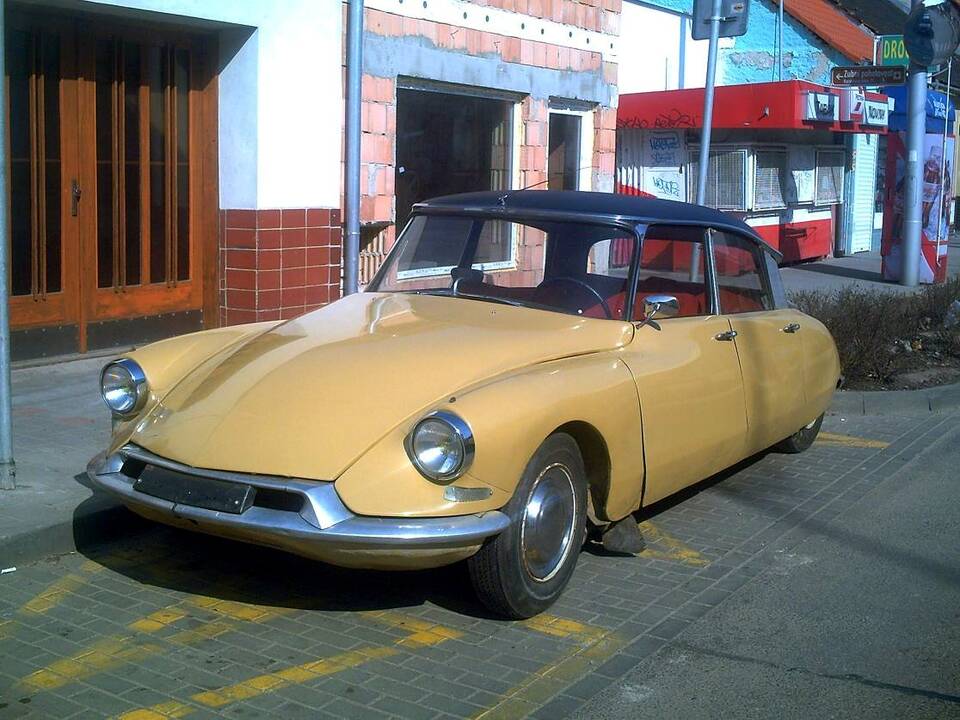
First-series Citroën DS 19 · Radek Weigel · Public domain (PD-self)
Research pending
A matching completed auction sale has not been verified for this exact year, body, trim, engine, transmission and market.
Joyride shows this gap instead of substituting an asking price, unsold bid or mismatched special vehicle.
More than a set of wheels.
Citroën unveiled the DS 19 in Paris in October 1955. Its smooth body was only the beginning: a high-pressure hydraulic system powered the suspension, steering, brakes and clutch-and-gear controls. This page stays with the original 1,911 cc launch specification, not the later and more powerful DS models. The cover is a representative first-series 1955–1962 car; its exact build year is not proven.
Look a little closer.
In French, saying “DS” sounds like déesse—the word for goddess. That suited a car that seemed almost unbelievable in 1955.
Photos show an example of the model or generation. The pictured vehicle’s year, equipment, or modifications can differ from the specification described here.
Why the car could rise
Each wheel’s suspension uses pressurised hydraulic fluid and gas-filled spheres. The gas acts like a spring, while the hydraulic system keeps the car at a chosen height as passengers or luggage are added.
Source: Citromuseum · 1955 DS 19 chassis 32 ↗Braking with a button
The original DS used a small floor button instead of a normal long-travel brake pedal. High hydraulic pressure provided the force, and front disc brakes—still unusual on a production car in 1955—handled much of the stopping work.
Source: The Autocar · 1955 DS 19 road test archive ↗Where these facts come from
- Citroën Origins · DS archive
- DS Automobiles · 70 years of the DS
- Citromuseum · 1955 DS 19 chassis 32
- The Autocar · 1955 DS 19 road test archive
Selected facts checked for this edition. Some source pages link to broader model families. Last reviewed September 29, 2026.