
Renault 40CV Type JV1
Renault’s giant flagship paired a nine-litre six-cylinder engine with coachbuilt luxury and a new patented servo-brake system.
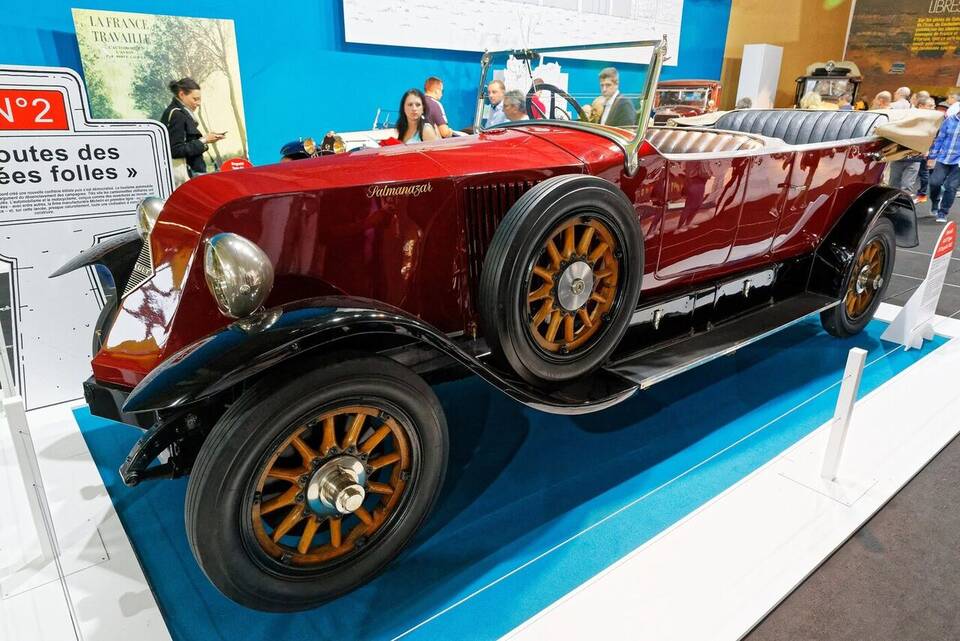
Renault 40 CV Type JV Torpedo - 1922 - Mondial de l'Automobile de Paris 2018 - 002.jpg · Thesupermat · CC BY-SA 4.0
Research pending
A matching completed auction sale has not been verified for this exact year, body, trim, engine, transmission and market.
Joyride shows this gap instead of substituting an asking price, unsold bid or mismatched special vehicle.
More than a set of wheels.
The 40CV name covered a long-running Renault luxury family; this profile narrows it to the Type JV1 shown for 1922 in Renault’s heritage museum. The car was more than five metres long, weighed about 2.6 tonnes and could be ordered with Torpedo, coupé-limousine, landaulet and other coachwork. Renault says 190 JV and JV1 cars were built in 1922–1923, including 148 JV1s, and some served the French presidency. The model’s engineering challenge was simple to understand but hard to solve: a very heavy, fast car needed much more braking assistance than a light early automobile.
Look a little closer.
At about 5.2 metres long, the Type JV1 was longer than many modern three-row family vehicles—and Renault lists fuel use around 27 L/100 km.
Photos show an example of the model or generation. The pictured vehicle’s year, equipment, or modifications can differ from the specification described here.
The body was only half the purchase
Large luxury cars were commonly delivered as motorised chassis for a coachbuilder to dress. Renault offered a factory Torpedo, while customers could commission enclosed bodies; that is why two 1922 40CVs may look very different without being different mechanical families.
Source: Louwman Museum · Renault 40CV Type JP Touring Widerkehr ↗Braking became a flagship technology
Renault’s museum describes a patented servo-braking system replacing an all-muscle feel with assistance. For a 2.6-tonne car capable of period motorway-like speeds, stronger control mattered as much as the huge engine.
Source: The Originals Renault Museum · Type JV (40CV) ↗Where these facts come from
- The Originals Renault Museum · Type JV (40CV)
- Louwman Museum · Renault 40CV Type JP Touring Widerkehr
Selected facts checked for this edition. Some source pages link to broader model families. Last reviewed October 1, 2026.